
Penalty-Proof AI Assets: Build Funnels, Emails and Videos That Keep Your Accounts Safe

“Penalty-proof” doesn’t mean an asset can never be flagged, removed or questioned. No checklist can guarantee that. It means building and reviewing funnels, emails, videos, websites and lead magnets to be honest, compliant with relevant rules, useful to people and checked by a human, not designed to trick readers or search algorithms.
AI marketing automation and AI tools for affiliate marketing can make production faster. But speed doesn’t transfer responsibility. You’re still accountable for what your content claims, how it discloses affiliate relationships, and whether your marketing follows the rules of the platforms and affiliate programs you use.
If you’re building your first campaign, start with how to start affiliate marketing with AI and AI affiliate marketing 101. The same principles apply whether you’re drafting your first page or improving a full marketing workflow.
What “penalty-proof” should mean
A safer AI-built asset is not one that hides its automation or exploits a loophole. It’s one that:
- Helps a real audience with clear, relevant information.
- Makes affiliate relationships and other material connections easy to notice.
- Uses claims you can support and avoids promising guaranteed income or results.
- Adds human review, judgment and original value.
- Follows the rules for the channel and affiliate program involved.
That’s a working standard, not a legal guarantee. Laws and platform policies can change, and rules vary by location and program. Treat this article as general education, not legal advice.
The rules that matter most
1. Make affiliate disclosures clear and close to the recommendation
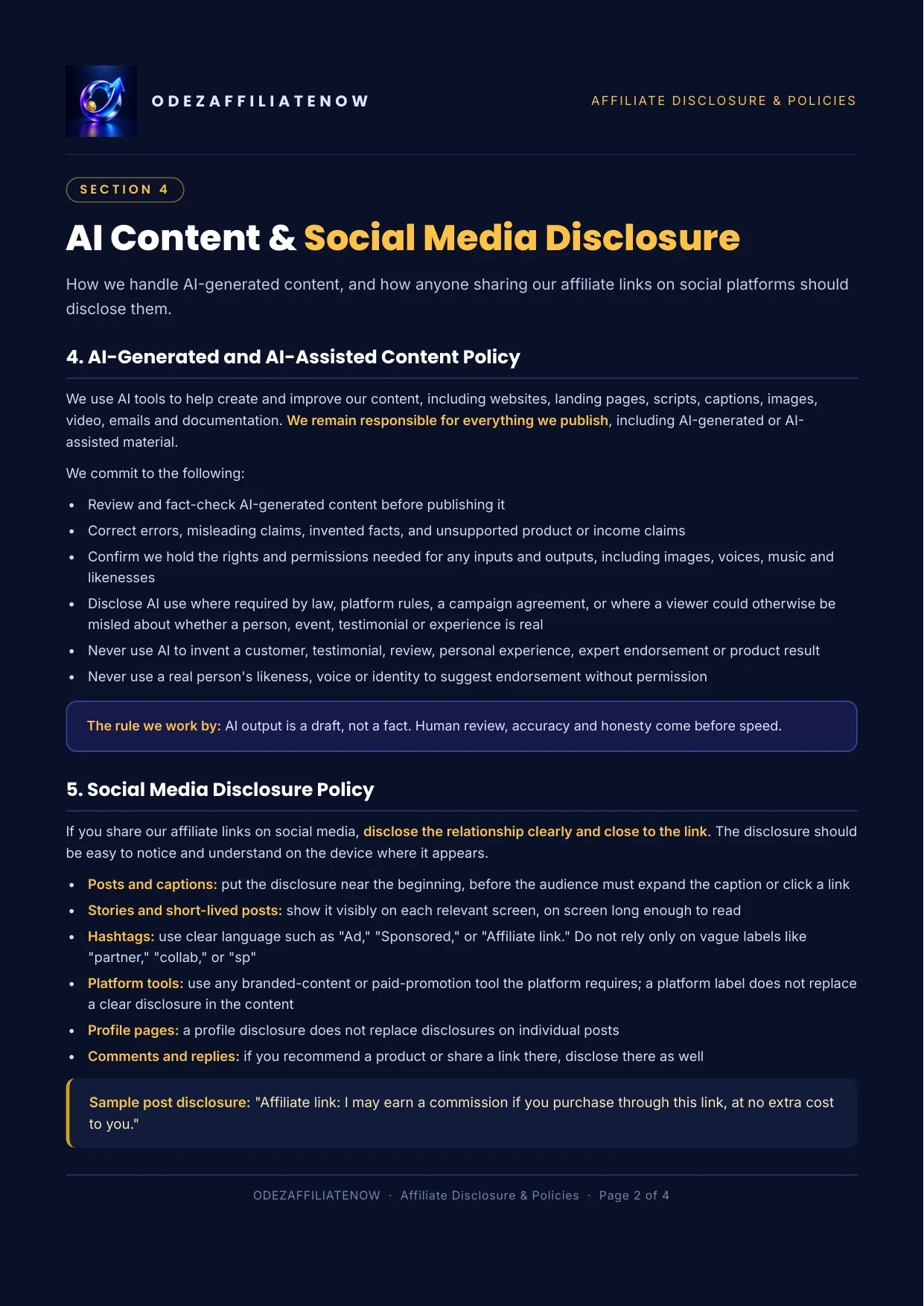
If you could earn a commission or receive another benefit from an endorsement, disclose that relationship in plain language where people will see it. A disclosure hidden in a footer, profile or separate policy page may not be enough. “Affiliate link” alone may not tell everyone that you can be paid.
For example:
Disclosure: I may earn a commission if you buy through links in this post.
Use wording that accurately describes your relationship. Add “at no extra cost to you” only if that’s true for the offer.
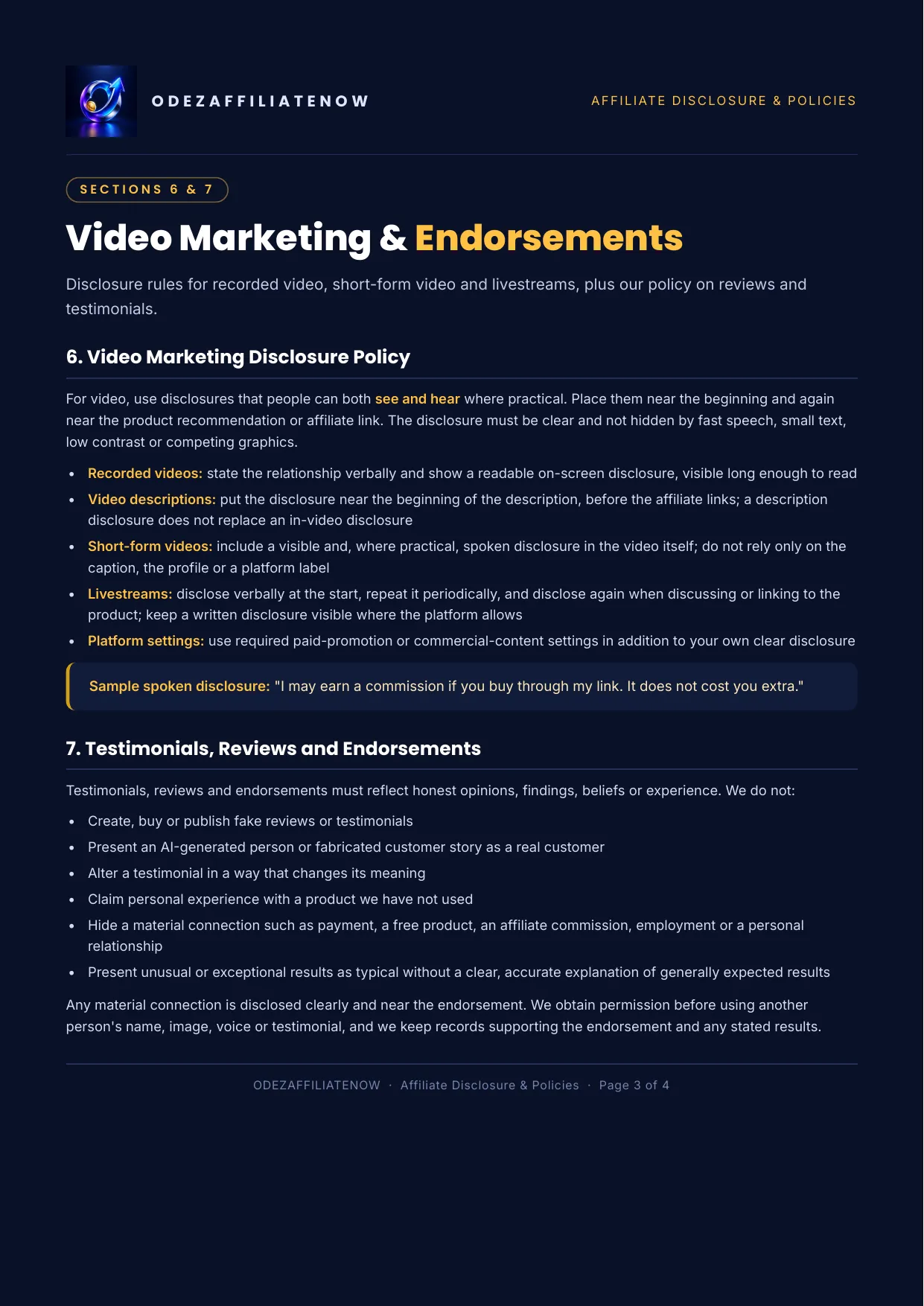
For a web page, put the disclosure near the relevant recommendation or link. For a social post, place it where viewers can see it without opening a collapsed caption. In a video, put the disclosure in the video, not only in its description. When the endorsement is both visual and spoken, use a visible disclosure and say it aloud. Put another disclosure near affiliate links in the description where appropriate.
The FTC’s endorsement guidance explains how disclosures should be clear and conspicuous. ODEZAFFILIATENOW also offers practical affiliate disclosure guidance and an affiliate disclosure and policies page.
2. Avoid guaranteed income and unsupported claims
Don’t promise that a product, funnel, email sequence or AI tool will generate a specific income or result for everyone. Results vary, and any performance claim needs appropriate support. A disclosure does not make a misleading or unsupported claim acceptable.
Don’t use AI to invent a testimonial, product feature, customer story, personal experience or statistic. If you haven’t used a product, don’t imply that you have. Instead, describe what you reviewed and distinguish verified facts from your own opinion.
3. Make search content valuable, not just abundant
Google’s Search spam policies don’t prohibit AI-assisted writing as such. They do prohibit scaled content produced primarily to manipulate rankings rather than help people. That includes low-value pages whether they’re created by AI, people or a mix of methods.
A useful affiliate page should contribute something beyond a copied product description or a string of links. Add relevant explanations, a meaningful comparison, original research, a practical demonstration or clearly described experience. Make the page useful even to someone who doesn’t click an affiliate link.
For ideas on connecting relevant links and reader next steps, see the hypertext affiliate playbook and funnel builder basics.
4. Check affiliate program terms before promoting
Affiliate terms differ. Check what your program allows before using an advertising method, especially paid search. Some programs restrict brand-name bidding, direct linking, certain ad platforms, coupon promotions or how their name appears in ad copy.
Don’t assume that a tactic allowed by an ad platform is allowed by the affiliate program. Read the current agreement and ask the program for clarification where needed. Violating its terms could affect commissions or your account.
5. Follow the basics for commercial email
For U.S. commercial email, the FTC’s CAN-SPAM compliance guide covers core requirements. In brief: use accurate sender information and subject lines, include a valid postal address, provide a clear way to unsubscribe, and honor opt-out requests within the required timeframe. Don’t make signing up misleading, and only send messages consistent with what subscribers were told to expect.
Your email platform may offer tools for unsubscribe links and suppression lists, but you’re responsible for setting them up and using them properly. Requirements can differ outside the United States.
Where AI helps, and where human judgment matters
AI can help brainstorm topics, organize notes, draft a page outline, create alternate headlines, repurpose an approved script, or format a lead magnet. It can also help you review a checklist or spot unclear wording.
But AI can make mistakes, miss context and sound certain without evidence. A person needs to verify current prices, features, policies, legal requirements and affiliate terms. A person should also decide whether the recommendation fits the audience, whether the tone feels trustworthy and whether the content adds genuine value.
Our AI tools roundup explores ways tools can support the work. For a practical workflow, see ODEZAFFILIATENOW’s AI content workflow guide: AI output is a draft, not a fact.
A pre-publishing checklist for any AI-built asset
Use this before publishing a funnel, website, email, video, social post or downloadable lead magnet:
- Facts checked: Have you verified product details, prices, features, links and policy references against reliable, current sources?
- Claims supported: Can you support each objective claim? Have you removed guaranteed income, invented testimonials and unverified results?
- Disclosure present: Is the affiliate or other material relationship described clearly, close to the recommendation and visible in the format?
- Channel rules checked: Have you reviewed the platform’s policies and the relevant affiliate program’s terms, including ad restrictions?
- Links and forms tested: Do buttons, affiliate links, sign-up forms and unsubscribe links work? Do they lead where the labels say they will?
- Human tone added: Have you edited out generic or misleading language and made the content specific, clear and helpful?
- Original value included: Does the asset offer useful insight beyond repeating a product page or another article?
- Email basics covered: If it’s commercial email, are sender details accurate, the subject line honest, a postal address included and opt-out handled correctly?
For video, check that disclosures are readable for long enough and audible where appropriate. ODEZAFFILIATENOW’s video marketing and endorsements policy page shows how these standards can be incorporated into a content workflow.
Build a repeatable, careful workflow
A simple process works across formats: gather reliable source material, ask AI for a draft, review every factual claim, add your own useful perspective, place disclosures where people can see them, and test the final asset before it goes live. Keep a record of important sources and update content when product details or policies change.
That approach can make AI marketing automation more manageable without pretending that more output automatically means better marketing. Helpful affiliate marketing tips start with respect for the reader: explain what you know, disclose what you stand to gain, and avoid pressure or promises you can’t support.
ODEZAFFILIATENOW builds AI-assisted funnels, email sequences, video shorts, websites and lead magnets with these standards in mind. If you’d like to discuss a project, contact odezmedia@gmail.com. The goal is to help make the work easier to organize and review, not to promise a particular business outcome.